

The Most Famous Sleep Advice in History
Almost everyone has heard it - if you cannot sleep, just count sheep. The image is endearing. Fluffy white sheep, one by one, leaping over a wooden fence while you drift peacefully off to dreamland. But does it actually work? And if not, what should you do instead when your brain refuses to switch off at night?
What the Research Says
Surprisingly, counting sheep has actually been studied. A well-known experiment at Oxford University in 2002 tested whether counting sheep helped people fall asleep faster. The result was clear - it did not. In fact, the sheep-counting group took slightly longer to fall asleep than the control group. The researchers suggested that counting sheep is simply too boring to hold your attention, which means your mind quickly wanders back to the worries and thoughts that were keeping you awake in the first place.
What did work, however, was asking participants to visualise a calm, engaging scene - like a beach, a waterfall, or a peaceful forest. This technique, known as guided imagery, was effective because it occupied enough of the brain's processing capacity to crowd out anxious thoughts while still being relaxing enough to promote sleep.
Why Your Brain Needs Distraction, Not Repetition
The core problem with counting sheep is that it is too simple. Your brain can count and worry simultaneously - the counting does not take up enough mental bandwidth to interrupt the thought patterns that are keeping you awake. What you need is a task that is engaging enough to hold your attention but calm enough to not stimulate you further.
Think of it as giving your brain a gentle puzzle to chew on instead of the stressful problems it keeps circling back to.
Techniques That Actually Work
Guided Imagery
Visualise a detailed, peaceful scene. A quiet beach with waves rolling in, the warmth of the sun, the texture of the sand, the sound of seagulls. The more sensory detail you include, the more effectively it occupies your mind. This is the technique that outperformed counting sheep in the Oxford study.
The 4-7-8 Breathing Method
Inhale through your nose for 4 counts, hold for 7, and exhale slowly through your mouth for 8. This activates your parasympathetic nervous system and physically slows your heart rate. The counting component gives your brain something to focus on while the breathing pattern triggers genuine relaxation.
Progressive Muscle Relaxation
Starting from your toes and working up to your head, tense each muscle group for five seconds and then release. The contrast between tension and relaxation helps your body physically let go of the stress it has been carrying. Many people fall asleep before they even reach their shoulders.
Listen to Something Calming
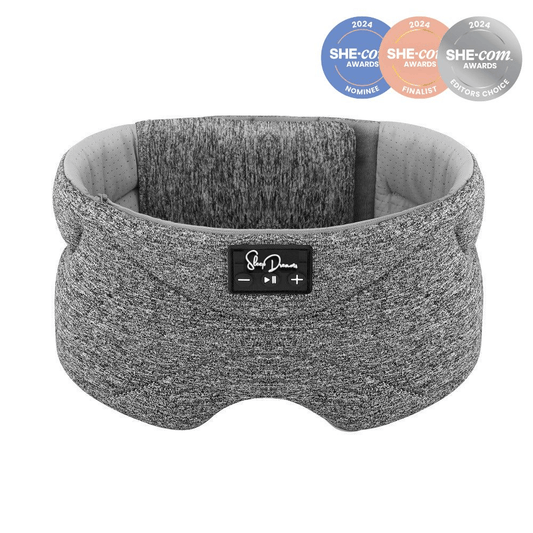
Sleep stories, guided meditations, ambient music, or nature sounds through sleep headphones give your brain a steady, calming input to focus on. This is particularly effective for people whose primary barrier is a racing mind - the external audio replaces the internal chatter with something gentle and predictable.
The Cognitive Shuffle
Think of a random word - say "garden" - and then visualise an object for each letter (G - guitar, A - apple, R - rabbit, and so on). The randomness prevents your brain from forming coherent worry chains, and the gentle effort of coming up with images occupies just enough mental space to quieten anxious thought patterns. It was developed by a cognitive scientist specifically as a sleep tool.
When Simple Techniques Are Not Enough
If you have tried these approaches consistently for several weeks and still struggle to fall asleep, there may be an underlying issue worth addressing - whether that is anxiety, a disrupted sleep schedule, or an environmental problem like noise or light. Our sleep calculator can help you check that your bedtime aligns with your natural cycles.
"The cognitive shuffle technique is honestly magic. I pick a random word and start picturing objects for each letter and I am usually asleep before I finish the word. My brain cannot hold onto worries when it is busy thinking about bananas and kangaroos."
- Tom R., Canberra ★★★★★
"I tried counting sheep for years and it never worked. Switched to a guided sleep meditation through the sleep headphones and I am out within ten minutes now. Giving my brain something to actually listen to was the missing piece."
- Rachel K., Melbourne ★★★★★